


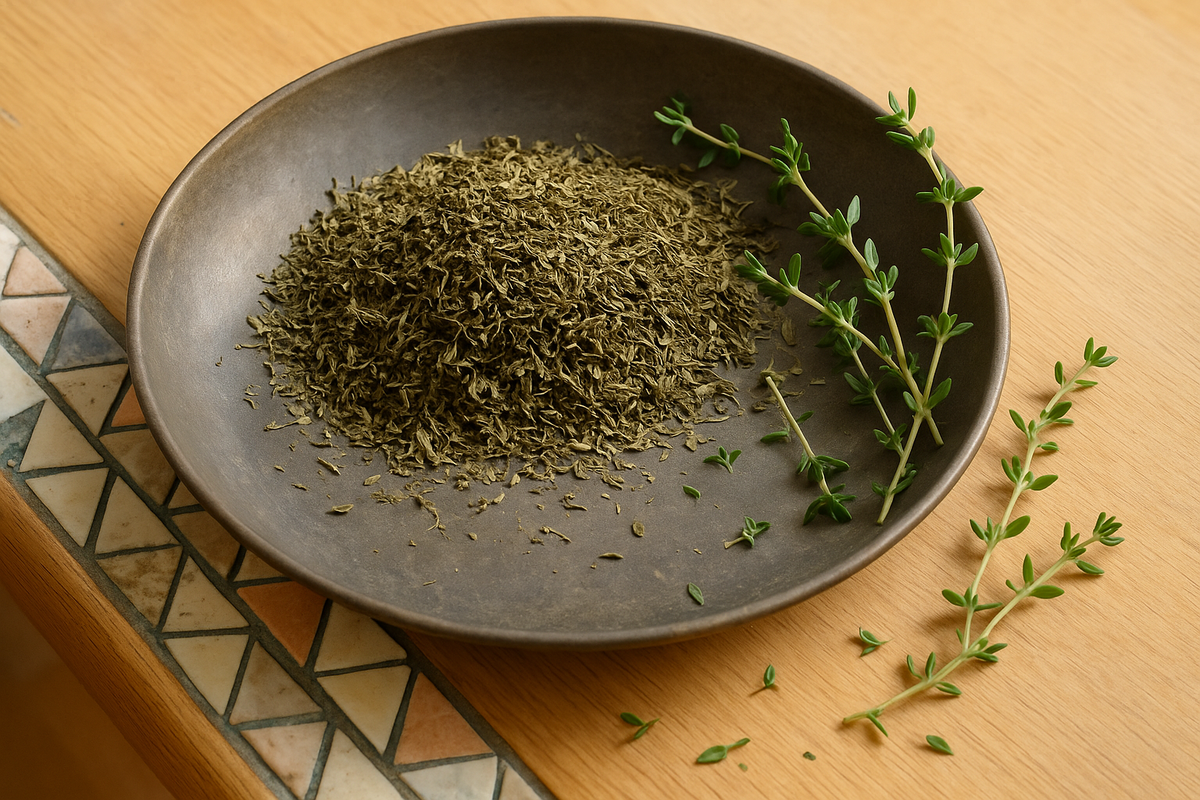
Nutrition
| Per 100 g | Per 1 oz (28 g) | |
|---|---|---|
| Energy | 281 kcal | 80 kcal |
| Protein | 15.6 g | 4.4 g |
| Fat | 4.7 g | 1.3 g |
| saturated | 1.3 g | 0.4 g |
| Carbohydrate | 29.2 g | 8.3 g |
| sugars | 0 g | 0 g |
| Fibre | 38.9 g | 11 g |
| Sodium | 25 mg | 7 mg |
Estimated from the ingredients, for the finished dried product. Actual values vary with the produce you use and how far you dry it.
Ingredients
- 650 g fresh thyme sprigs
Instructions
- Thyme is the herb that loses least in a dehydrator, which is why it is worth doing a lot of at once. It keeps more than a third of its weight and most of its aroma, and that is why it is in every dry rub worth making.
- Cut the sprigs in the morning after the dew has cleared, while the plant is at its most aromatic and before the day takes the edge off it.
- Give them a quick rinse and shake the water out, then let them sit on a cloth for a few minutes. There is not much surface for water to cling to here, and it goes quickly.
- The leaves stay on the stem. They are far too small to pick off while damp, and once the sprig is dry they come away in seconds.
- Spread the sprigs across a fine mesh insert in a loose, open layer. A packed layer has no path through it for the air, and thyme sprigs are light enough for the fan to shift on a bare tray.
- Dry at 40 °C for 6 hours. At the midpoint the test is the stem, not the leaf: a finished stem snaps cleanly instead of bending, and the leaves rattle when the tray is moved.
- Let it all cool on the tray for a few minutes. A hot sprig feels more finished than it is, and glass filled warm will sweat.
- To strip it, hold the top of a stem and run a thumb and finger down it against the direction of growth; the leaves come off in one movement. Expect well over a third of the fresh weight back.
- A tight jar in a dark cupboard is all it needs. Take a look at the glass after a week — if it has misted, some of the stem was still wet and the lot goes back in.


